Can You Bleach and Colour Raw Indian Hair? A Salon Professional's Honest Answer
- Subhani
- Aug 11
- 9 min read

Updated: Aug 12
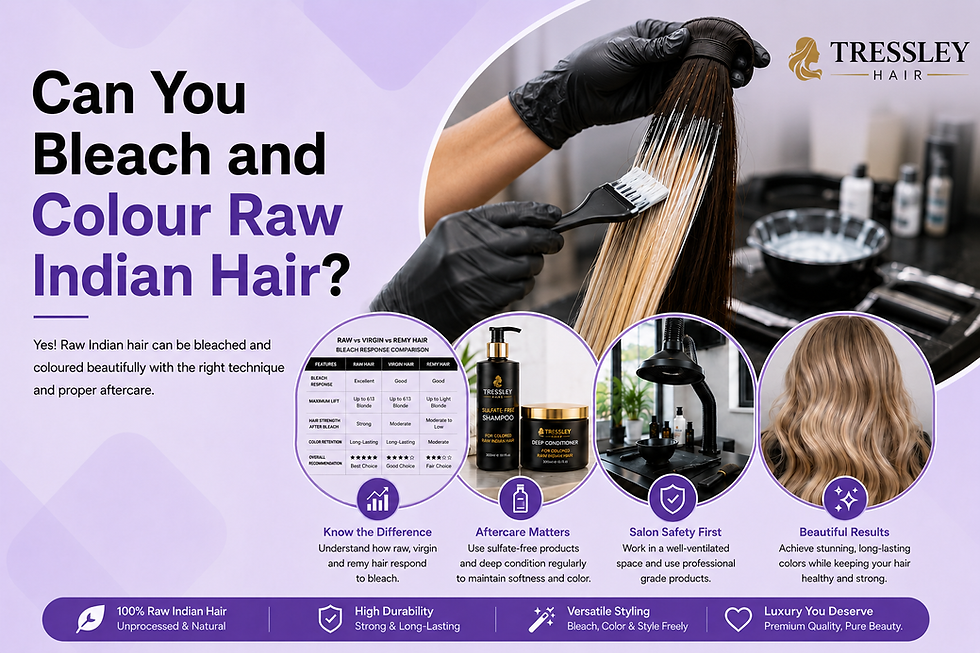
Yes, you can bleach and color raw Indian hair. It takes color better than almost any other extension hair on the market. Raw Indian hair has never touched a chemical before it reaches you, so the cuticle layer is fully intact from day one. That intact cuticle is exactly why colorists reach for it when a client wants platinum blonde, balayage, or a bold fashion color.
But "yes" is not the full story. Raw Indian hair still has limits. Push past them and it breaks down the same way your own hair would under too much bleach. This guide walks through what actually happens when you lift raw Indian hair, how far you can safely go, and the mistakes that turn a premium bundle into straw.
Key Highlights
Raw Indian hair can be bleached and colored because it is 100% unprocessed, single-donor human hair with an intact cuticle layer.
Most colorists can safely lift raw Indian hair 4 to 6 levels in one session without extra bond protection.
Reaching 8 to 9 levels requires two or three sessions spaced weeks apart, with a bond builder used throughout.
Bleach strips eumelanin, the dark pigment, first, which is why dark hair passes through red and orange stages before reaching blonde.
The U.S. Food and Drug Administration recommends a 48-hour patch test before any dye or bleach service, salon or at-home.
Skipping a strand test is the single most common reason colorists misjudge how a raw hair bundle will lift.
Aftercare matters as much as the bleach process itself, since color fades faster on porous, under-conditioned hair.
Dermatologists recommend wearing extensions no longer than two to three months at a time to protect the natural hair underneath.
Quick Answer
Raw Indian hair can be bleached and colored because it is 100% unprocessed, single-donor human hair with an intact cuticle. Most colorists can lift raw Indian hair 4 to 6 levels in one session without extra bond protection, and up to 8 or 9 levels across two or three sessions when a bond builder is used throughout. Because the hair was never pre-lightened, steamed, or silicone-coated before you bought it, it lifts more evenly and predictably than commercial "virgin" hair that has already been through a factory process. The real risk is speed. Using a high-volume developer to rush the lift damages the cortex just as fast as it would on natural growing hair. Strand test first, work in small sections, and add a bond protectant from the very first application rather than after damage already shows.
What Makes Can You Bleach and Colour Raw Indian Hair? Different Once You Add Bleach
Most extension hair on the market has already been processed before it ships. Factories steam it for uniform waves, dye it darker for a "natural black" look, or coat it in silicone to fake shine. That prior processing already used up some of the hair's chemical tolerance.
Raw Indian hair skips all of that. It comes straight from a single donor with the cuticle scales still pointing the same direction. Colourist's call this cuticle alignment, and it is the reason raw hair resists tangling and takes lightener evenly across a bundle instead of in blotchy patches.
The colour you start with also matters. Natural raw Indian hair is not usually jet black. It typically falls in the Natural 1B to dark brown range, which means it already carries less artificial pigment for bleach to fight through than dyed "natural black" commercial hair.
Can You Bleach Raw Indian Hair Without Ruining It?
Bleach works by breaking down the pigment inside the hair shaft, called melanin. According to the National Institutes of Health, human hair pigment is a mix of eumelanin, which creates black and brown tones, and pheomelanin, which creates red and yellow tones. Bleach strips eumelanin first, which is why dark hair often turns orange or red before it reaches blonde.
Raw Indian hair usually contains high eumelanin with very little pheomelanin. That gives it a cleaner lift path, but it still needs to pass through the same warm stages every dark hair goes through on its way to blonde.
Hydrogen peroxide, the active lightening agent in bleach, is reviewed as safe for professional and at-home hair use when manufacturer directions are followed, including a patch test and limited processing time, according to cosmetic ingredient safety reviewers who reference FDA guidance.2 The FDA's own consumer guidance on hair dye recommends a patch test 48 hours before every colour service, at home or in a salon, and repeating that test each time a new product is used.3 The same rule applies to raw Indian hair extensions. Follow strand tests and timing limits, and the hair tolerates bleach well. Skip them, and even the best raw hair can snap.
Raw vs Virgin vs Remy: Which One Colours Best?
Buyers often assume "raw," "virgin," and "Remy" all mean the same thing. They do not, and the difference shows up clearly once bleach gets involved.
Hair Type | Prior Processing | Donor Source | Bleach Response |
Raw Indian Hair | None. Zero chemical or steam processing. | Single donor | Lifts evenly, highest chemical tolerance |
Virgin Indian Hair | Sometimes light steam for wave pattern | Often multiple donors | Lifts well, minor texture shifts possible |
Commercial Remy Hair | Often dyed, silicone-coated, or pre-lightened | Usually mixed or blended | Unpredictable, prone to breakage under bleach |
For a deeper breakdown of how these three categories differ beyond color, see this comparison of virgin Indian hair versus raw Indian hair and this side-by-side of Remy hair versus raw hair for wholesale buyers.
How Many Levels Can You Safely Lift Raw Indian Hair?
This is the question every colourist actually wants answered. The honest range depends on the starting shade and the client's patience.
In one session: Most raw Indian hair lifts 4 to 6 levels safely with a standard 20 to 30 volume developer and a bond-building additive mixed into the bleach.
Across two to three sessions: You can reach 8 to 9 levels, taking the hair close to a pale blonde, by spacing sessions two to three weeks apart and deep conditioning between appointments.
In a single aggressive session: Going past 6 levels in one sitting with 40 volume developer is where most breakage happens, even on raw hair. The cortex simply cannot rebuild bonds that fast.
The American Academy of Dermatology advises staying within roughly three shades of the starting colour whenever possible, noting that lightening hair more than that requires higher peroxide volumes and causes more damage.4 That guidance was written for natural growing hair, but it applies just as directly to a raw Indian hair bundle, since the strand chemistry is the same.
A rule salon colourist's rely on: if the hair loses elasticity and stops stretching and springing back when wet, stop the session immediately, regardless of the colour result.
Step-by-Step: How a Salon Coloristic Should Bleach Raw Indian Hair
Strand test first. Cut a small piece from an inconspicuous weft section and process it exactly as planned. Check elasticity before touching the full bundle.
Mix bleach with a bond builder from the start. Adding it after the first session is too late to protect the bonds already broken.
Section the hair into four to six parts. This keeps developer timing even across the whole head or bundle.
Watch for the warm stages. Dark raw hair typically moves through red, then orange, then yellow, before reaching pale yellow-blonde.
Rinse at the target stage, not before. Rinsing too early leaves patchy warmth that toner cannot fully fix.
Tone immediately after rinsing. A purple or blue-based toner neutralizes the remaining warmth and locks in a cleaner final shade.
Deep condition before the client leaves. A bond-repair mask seals the cuticle and reduces friction damage during the first few washes.
Common Mistakes That Damage Raw Indian Hair During Colouring
Salon buyers and DIY colourist's run into the same handful of problems repeatedly.
Skipping the strand test. Every donor bundle lifts slightly differently, even within the same shipment, because it comes from a real person rather than a factory blend.
Using too high a developer volume to save time. A 40 volume developer lifts faster, but it also breaks disulphide bonds faster than the hair can tolerate in one sitting.
Applying heat right after colour. Freshly bleached hair is at its weakest point. Wait at least 48 hours before flat ironing or curling.
Assuming "raw" means indestructible. Raw Indian hair tolerates more processing than pre-treated commercial hair, but it is still human hair with a chemical breaking point.
Wearing the same install for too long. Dermatologists recommend limiting any weave or extension install to two or three months before giving the hair underneath a break, both for scalp health and for keeping coloured hair from over-processing at the root reattachment point.
Aftercare: Keeping Coloured Raw Indian Hair Healthy
Bleached hair, whether it is growing on a scalp or sewn into a weft bundle, needs a different care routine than untouched hair.
Wash with sulphate-free shampoo to avoid stripping the toner early. Deep condition weekly rather than just when the hair feels dry. Store coloured bundles away from direct sunlight when not in use, since UV exposure fades toner faster than washing does. Limit heat tools to below 350°F and always use a heat protectant spray first.
The American Academy of Dermatology also notes that sun exposure alone can make hair weak, dry, and faded, an effect that is more pronounced once hair has already been lightened. A wide-brimmed hat or a leave-in product with UV filters helps protect color longevity between salon visits, especially for clients in sun-heavy markets like Australia, the UAE, and South Africa.
Buyer's Guide: What to Ask a Raw Hair Vendor Before You Colour
Before you commit to bleaching a bundle, confirm the following with your supplier.
Is this truly single-donor hair, or a blended batch? Blended bundles can lift unevenly because different donors respond differently to the same developer.
Has the hair had any prior processing? Some sellers market "raw" hair that has actually been steamed or colour-corrected. Read more on what genuinely unprocessed raw Indian hair looks like before it reaches a colorist.
What is the natural starting shade? Knowing whether you are starting from Natural 1B or a deeper dark brown changes how many sessions a client should budget for.
Do they offer sample bundles for testing? Reputable wholesale suppliers will let salon buyers test-lift a small sample before committing to a bulk order.
What does batch-to-batch consistency look like? For resellers building a private label, this determines whether repeat customers get a predictable result.
Salon Safety: What Chemical Exposure Guidance Means for Bleaching Services
Colouring raw Indian hair in a professional setting is not only about protecting the strand. It is also about protecting the person performing the service. The Occupational Safety and Health Administration maintains dedicated guidance for salons on ventilation and chemical exposure during colouring and lightening services, since bleach, developer, and ammonia-based products can build up in poorly ventilated spaces.
A peer-reviewed scoping review of occupational chemical exposure in hairdressing found that airborne concentrations of common salon chemicals, including hydrogen peroxide, frequently varied with ventilation quality and the number of clients served per day. For salon owners buying raw Indian hair in bulk for in-house colouring services, working ventilation and proper mixing stations are not optional extras. They are part of running a compliant, client-safe bleaching operation.
Frequently Asked Questions
Does bleaching raw Indian hair void any quality guarantee? Most reputable suppliers guarantee the hair's unprocessed state on arrival, not the outcome of chemical services performed after purchase. Confirm this directly with your vendor before you colour.
Why did my raw Indian hair turn orange during bleaching? This is a normal stage, not a defect. Dark hair loses its cooler pigment first, which briefly exposes warm red and orange undertones before the hair lifts further.
Can you colour raw Indian hair without bleaching it first? Yes. Demi-permanent and semi-permanent colour can deposit tone or darken raw hair without lifting it, which is a lower-risk option for subtle changes.
Is raw Indian hair more expensive to colour than synthetic-blended extensions? Tressley Hair works exclusively in 100% human hair, so this comparison does not apply to our product line. Compared to other human hair types, raw hair often costs less in the long run because it tolerates more colour sessions before it needs replacing.
How long does colour last on raw Indian hair extensions? With sulfate-free aftercare and limited heat exposure, colour on raw Indian hair typically holds its vibrancy for 6 to 10 weeks before a toner refresh is needed.
Do I need a patch test before colouring extensions, even though they are not attached to my scalp? If the colour service involves any product touching the scalp during application or removal, FDA patch-test guidance still applies. For extensions coloured off-head before install, a strand test for hair integrity replaces the skin patch test.
The Bottom Line
Raw Indian hair earns its reputation among colourist's for a reason. Its untouched cuticle and single-donor consistency give you a cleaner, more predictable lift than almost any other extension hair. Respect the same limits you would with natural hair, and it rewards you with colour that looks salon-fresh for months. Learn more about sourcing and quality standards behind every Tressley bundle, or request a wholesale quote to test a sample batch before your next colour service.


Comments