Closure vs Frontal: What's the Difference?

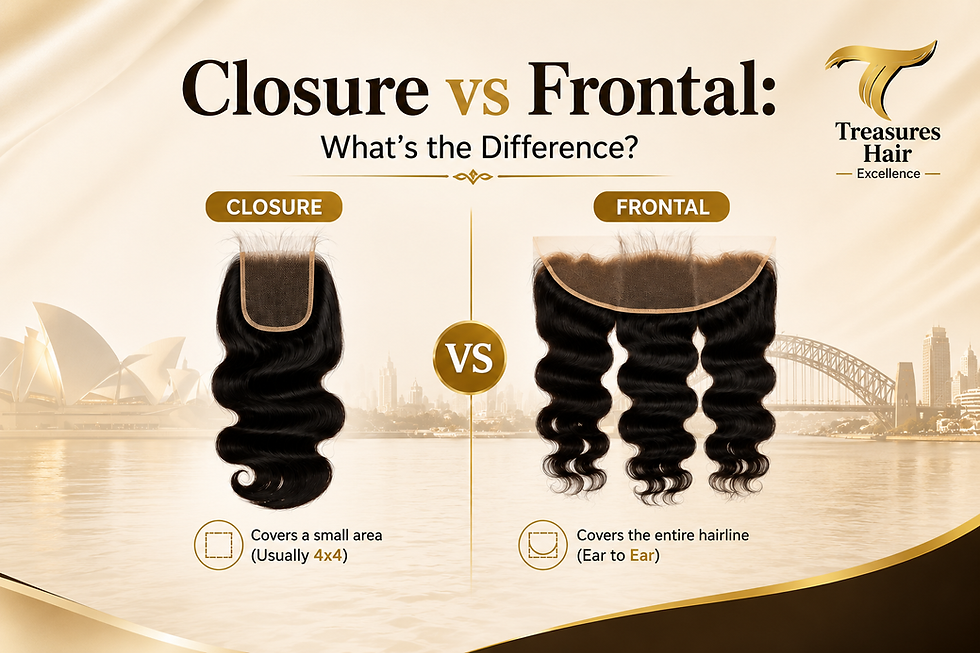
A closure is a small, square lace piece, generally 4x4 to 6x6 inches, placed at the crown of the head to close off a sew-in install with a natural, believable part. A frontal is a much larger, ear-to-ear lace piece, typically around 13 inches by 4 inches, that recreates the entire front hairline and allows the hair to be styled away from the face in ways a closure cannot support. Closures cost less, install faster, and suit wearers who want a simple, consistent part without dramatic styling changes. Frontals cost more, take longer to install correctly, and suit wearers who want full styling freedom, including high ponytails, updos, and slicked-back looks. Neither is a universal upgrade over the other. The right choice depends entirely on how you actually plan to wear your hair.
Key Highlights of Closure vs Frontal: What's the Difference?
A closure typically measures 4x4, 5x5, or 6x6 inches and covers the crown, while a frontal measures roughly 13 inches by 4 inches and covers the full hairline from ear to ear.
Frontals allow styles that pull hair away from the face, including high ponytails and slicked-back looks, while closures are built around a fixed, more central parting area.
Closures are generally more affordable and faster to install, while frontals cost more and take longer to apply correctly.
Neither option is "better" in an absolute sense. The right choice depends on how you actually want to style your hair day to day.
Frontals require more frequent maintenance at the hairline, since that lace edge experiences more direct handling and adhesive exposure over time.
Both products carry the same documented skin-safety considerations around adhesive use, regardless of size.
A closure and a frontal both use lace and hand-tied human hair to create a natural-looking scalp, but they are built to do genuinely different jobs. A closure is a small, square lace piece, typically 4x4, 5x5, or 6x6 inches, that sits at the crown of the head and closes off a sew-in install at a natural parting point. A frontal is a much larger, rectangular lace piece, usually around 13 inches by 4 inches, that stretches from ear to ear and recreates the entire front hairline.
That size difference sounds simple, but it drives nearly every other decision in this comparison: cost, styling freedom, installation time, and how much of your own hair stays protected underneath. This guide breaks down exactly what separates a closure from a frontal, who each one actually suits, and how to decide without guessing.
What a Closure Actually Is
A lace closure is a smaller hairpiece, most commonly available in 4x4, 5x5, or 6x6 inch sizes, with human hair hand-tied into a lace base one strand at a time. It sits at the top and crown of the head, covering what stylists sometimes call the "horseshoe" section, the central area where a natural part is most commonly worn.
Because a closure only covers this central section, it works alongside weft bundles in a sew-in install, or as the crown piece of a closure wig, rather than replacing the entire front hairline. A full breakdown of 4x4 closures specifically covers the construction and sizing details in more depth, and the same fundamentals apply across the 5x5 and 6x6 size range as well, as explored in this 4x4 versus 5x5 comparison.
What a Frontal Actually Is
A lace frontal is a significantly larger, rectangular lace piece, typically spanning around 13 inches from ear to ear and roughly 4 inches deep. It replicates the entire front hairline rather than just a central parting section, which means it can be styled in ways a closure simply cannot support.
Because a frontal covers the full width of the hairline, wearers can pull their hair completely away from their face, into a high ponytail, a sleek bun, or a slicked-back look, without exposing any of their own natural hairline underneath. This is the single biggest practical advantage a frontal offers over a closure, and it is also the main reason frontals cost more and take longer to install correctly.
Closure vs Frontal: Full Comparison
Factor | Lace Closure | Lace Frontal |
Typical size | 4x4, 5x5, or 6x6 inches | Approximately 13 inches by 4 inches |
Coverage area | Crown and central parting section | Full hairline, ear to ear |
Styling freedom | Middle, side, or diagonal parts within its area | Any part, plus ponytails, updos, and pulled-back styles |
Installation time | Generally faster | Generally longer, requires precise hairline blending |
Typical price | Lower | Higher |
Maintenance frequency | Moderate | More frequent, due to larger exposed lace edge |
Best suited for | Everyday, consistent-part wear | Versatile styling and pulled-back looks |
Beginner-friendliness | Easier for first-time wearers | Requires more installation experience |
Both pieces can be built from the same underlying raw, single-donor hair and the same lace grade, whether Swiss or HD, as covered in this guide to HD lace versus Swiss lace. The choice between closure and frontal is a decision about coverage and styling need, not a decision about underlying hair quality.
Why Frontals Cost More Than Closures
The price gap between closures and frontals reflects real, measurable differences in material and labor, not arbitrary premium pricing. A standard frontal covers roughly three to four times the lace surface area of a standard 4x4 closure, which means proportionally more hand-tied hair strands are required to achieve the same density across that larger space.
Since hand-tying hair into lace is a slow, skilled process performed strand by strand, this larger surface area translates directly into more production hours per unit. Buyers comparing prices across suppliers should expect this cost difference to scale roughly with the size difference between the two products, and a frontal priced suspiciously close to a closure from the same supplier is worth questioning before purchase.

Which One Fits Your Actual Styling Habits
Choosing between a closure and a frontal comes down to one honest question: how do you actually want to wear your hair day to day, not how you imagine wearing it occasionally.
You mostly wear your hair down, with a consistent part. A closure provides everything you need here, at a lower cost and with less daily maintenance than a frontal would require.
You frequently want a high ponytail, bun, or slicked-back look. Only a frontal can support these styles convincingly, since a closure's limited coverage area will expose your natural hairline the moment your hair is pulled back.
You switch between dramatically different part placements often. A larger closure, such as a 5x5 or 6x6, may provide enough flexibility, but a frontal offers the most complete freedom if your styling changes frequently and significantly.
You are installing your first-ever lace piece. A closure is generally the more forgiving starting point, since it requires less precise hairline blending than a frontal demands.
You want maximum protective styling for your natural hair with minimal daily manipulation. Either option works here, though a closure's smaller footprint generally means less overall handling of the perimeter during daily styling.
Installation Differences That Actually Matter
Both pieces install through similar core methods, sew-in or adhesive bonding, but the practical experience differs meaningfully between the two.
A closure installation is generally faster because there is less lace perimeter to blend and secure. Most experienced stylists can complete a closure install in a shorter session than a comparable frontal, which also means lower service costs at a salon charging by time.
A frontal installation requires more careful attention to the hairline, since that edge is the most visible, most scrutinized part of the entire piece. Getting the lace to sit flush against the skin, with knots bleached appropriately and baby hairs styled to blend the transition, takes more skill and more time than closing off a smaller, more central closure area.
Skin Safety: The Same Considerations Apply to Both
Adhesive-based installation carries documented skin safety considerations regardless of whether you are wearing a closure or a frontal. Peer-reviewed case reports have linked allergic contact dermatitis reactions to specific adhesive compounds used in wig and hairpiece attachment, including cyanoacrylate-based adhesives and certain acrylate compounds found in wig-fixing adhesive tapes.1,2 A broader review of hair-product contact dermatitis confirmed that reactions along the hairline are a recurring, documented pattern in dermatology practice, and this applies regardless of the specific lace piece's size or shape.3
Frontals do carry a larger total adhesive contact area than closures, simply because the hairline perimeter is longer across a 13-inch frontal than a 4 or 5 inch closure. This makes a patch test even more worthwhile before a full frontal install. The American Academy of Dermatology recommends this same patch-test approach for any product applied directly to the scalp or hairline, and salon professionals working with bonding adhesives should also follow standard ventilation practices consistent with occupational safety guidance for hair salons.4,5
Maintenance and Lifespan Differences
Both closures and frontals share the same fundamental lace and hair construction, so their baseline material lifespan is similar. The practical difference comes down to exposed edge length. A frontal's full ear-to-ear hairline experiences more cumulative adhesive removal and reapplication cycles than a closure's smaller, more central footprint, which generally means the frontal's lace edge shows visible wear somewhat sooner under equivalent care.
This aligns with what hair fiber weathering research describes as a progressive, mechanical wear pattern driven by repeated handling and friction.6 For a deeper breakdown of realistic wear expectations, see this honest guide to raw Indian hair lifespan, which applies to both closures and frontals since both use the same hair and lace fundamentals.
Frontals also typically require more frequent touch-up sessions, generally every two to four weeks, to reseal the longer hairline edge as adhesive naturally breaks down with washing, sweating, and general wear. Closures can often stretch slightly longer between touch-ups, simply due to their smaller adhesive footprint.
Color Matching: A Bigger Deal on Frontals Than Closures
Lace color matching matters for both products, but the stakes are higher on a frontal simply because more lace edge is visible across a wider span of the hairline. A slightly mismatched lace tone on a small 4x4 closure is less likely to draw attention than the same mismatch spread across a full 13-inch frontal hairline.
This is part of why frontal buyers should pay particularly close attention to available lace color options and tinting services when selecting a supplier. A closure with a slightly imperfect color match can often be styled around with careful parting, while a frontal with a poor color match is far harder to disguise once the hair is pulled back or styled away from the face.
Common Mistakes Buyers Make Choosing Between the Two
Buying a frontal for styling you will never actually do. If you never wear high ponytails or slicked-back looks, the extra cost and maintenance of a frontal may not be worth it over a closure.
Buying a closure expecting frontal-level styling freedom. A closure cannot support pulled-back styles the way a frontal can, and expecting otherwise leads to disappointment after purchase.
Assuming a frontal is always higher quality than a closure. Size and quality are separate specifications. A well-made closure from quality lace and hair outperforms a poorly constructed frontal in actual daily wear.
Underestimating frontal maintenance time and cost. The longer hairline edge on a frontal genuinely requires more frequent upkeep, which adds ongoing cost beyond the initial purchase price.
Choosing based on what looks trendy rather than what fits your actual hairline and lifestyle. A closure or frontal that works beautifully for one person's hairline shape and styling habits will not necessarily suit yours.
Blending With Bundles: How Each Piece Fits Into a Full Install
Neither a closure nor a frontal is typically worn alone. Both are usually paired with weft bundles to complete a full sew-in or wig install, and understanding how each piece integrates with bundles affects your total order planning.
A closure-based install generally uses the closure to finish the top and crown parting area, with bundles sewn in around and beneath it to provide overall length and volume. A frontal-based install uses the frontal to establish the entire front hairline, with bundles filling in the rest of the head behind it. Because a frontal covers more surface area at the front, some wearers find they need slightly fewer total bundles to achieve full coverage compared to a closure-based install, which is worth factoring into total cost calculations rather than looking at the closure or frontal price in isolation.
Import and Regulatory Considerations for Wholesale Buyers
Wholesale buyers stocking both products should know that customs classification treats them identically despite their size difference. U.S. Customs and Border Protection classifies human hair closures and frontals under the same Harmonized Tariff Schedule subheading, 6704.20.0000, the category covering wigs and similar articles made wholly of human hair.7 This means the same import documentation and duty framework applies to both products, with declared value, not product category, driving the main difference in landed cost.
Marketing claims about coverage, styling versatility, and sizing for either product should meet general truth-in-advertising standards as well. The Federal Trade Commission's guidance requires that specific product claims be accurate and substantiated, which applies directly to coverage and versatility claims made about either closures or frontals in reseller marketing.8
Wholesale Buyer's Guide: Stocking Both Products Strategically
Resellers deciding how to balance inventory between closures and frontals benefit from tracking actual customer behavior rather than assuming demand.
Track which product customers ask about more frequently for pulled-back styling questions. This signals genuine frontal demand versus customers who might be satisfied with a closure at a lower price point.
Confirm your wholesale supplier offers consistent lace grade and hair quality across both product lines. Customers who purchase a closure and later upgrade to a frontal expect the same quality experience.
Consider offering a starter bundle that pairs a closure with wefts at a lower total price point. This can serve price-sensitive or first-time buyers who are not yet ready for the frontal investment.
Educate customers on realistic maintenance expectations for frontals specifically. Setting accurate expectations upfront reduces returns and complaints tied to underestimated upkeep requirements.
Stock both in your most popular lace grade and density combinations first. This lets you test size and coverage preference without simultaneously testing every other variable in your catalog.
Frequently Asked Questions
Can I wear a high ponytail with a closure instead of a frontal?
Generally, no. A closure's limited coverage area will expose your natural hairline at the perimeter once your hair is pulled back, which is exactly why frontals exist for this specific styling need.
Is a frontal always better than a closure?
No. A frontal offers more styling freedom but costs more, takes longer to install, and requires more frequent maintenance. A closure is often the better choice for wearers who want a simple, consistent, lower-maintenance style.
Can a closure be upgraded to function like a frontal later?
Not directly, since the coverage area is fixed at the time of manufacturing. Wearers wanting frontal-level versatility need to purchase a frontal specifically rather than modifying an existing closure.
Do frontals damage natural hair more than closures?
Not inherently, provided both are installed and maintained properly. Excessive tension or overly long wear time without removal is the primary damage risk for either product, not the product category itself.
How much more does a frontal typically cost compared to a closure?
Pricing varies by supplier, but frontals generally cost noticeably more due to the larger lace and hair material required, often two to three times the price of a comparable closure from the same supplier.
The Bottom Line
Closures and frontals solve genuinely different styling problems, and the right choice comes down to how you actually plan to wear your hair rather than which option sounds more premium. A closure delivers a natural, affordable, low-maintenance part for everyday wear. A frontal delivers complete styling freedom at a higher cost and with more upkeep. Explore Tressley Hair's closures and frontals, backed by transparent sourcing standards, or request a wholesale quote to compare both before your next order.


Comments