Straight Raw Indian Hair Bundles: The Complete Buying and Care Guide

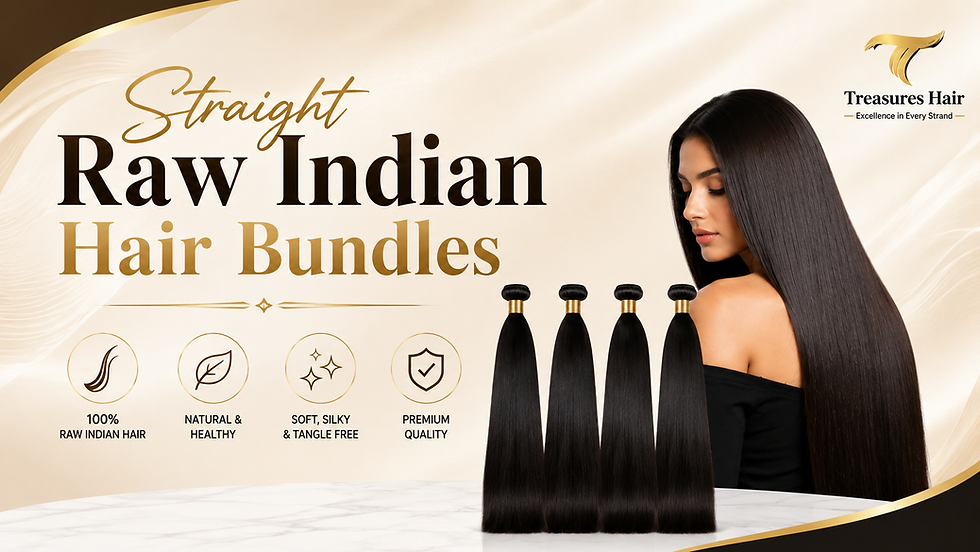
Straight raw Indian hair bundles are single-donor, completely unprocessed human hair that naturally grows straight, without any chemical or thermal straightening applied after collection. This texture comes from round, vertically oriented hair follicles, a genetic trait rather than a styling choice, which is why genuine straight raw hair maintains its smooth, consistent line even after washing and drying without any styling product. Straight raw Indian hair generally requires less daily maintenance than wavy or curly textures, blends most seamlessly with naturally straight or fine hair, and can still be temporarily curled or waved with heat styling tools when desired. Like other raw Indian hair textures, it can be safely bleached and colored following proper technique, and it typically lasts 2 to 4 years with consistent, proper care.
Key Highlights Straight Raw Indian Hair Bundles
Straight raw Indian hair grows from round, vertically positioned hair follicles, a genetic trait rather than a processed style.
Straight texture generally requires the least daily maintenance of the three natural raw Indian hair textures, making it a popular entry point for first-time extension wearers.
Genuine straight raw hair can be curled or waved temporarily with heat, and it reverts to its natural straight state after washing, a reliable authenticity check.
Straight bundles typically weigh slightly less than curly bundles at the same length, due to how texture affects how densely hair packs along a weft track.
Straight raw Indian hair blends most seamlessly with naturally straight or fine natural hair, though it can be styled to match wavier textures with the right technique.
Bleaching and coloring straight raw Indian hair follows the same safe process as other raw Indian hair textures, since texture does not change the hair's underlying chemistry.
Straight raw Indian hair bundles come from donors whose hair naturally grows straight, not from hair that has been chemically or thermally straightened after collection. That distinction sounds small, but it is the single biggest factor separating genuinely raw straight bundles from processed alternatives marketed under the same name, and it shapes everything from how the hair behaves in daily wear to how long it actually lasts.
This guide covers everything you need to know before buying straight raw Indian hair bundles, from the biology behind the texture, to how to verify authenticity, to styling and care specific to this particular texture.
The Biology Behind Naturally Straight Hair
Straight hair texture is determined at the follicle level, not by any external processing. A peer-reviewed review of hair fiber biology confirms that straighter, more rounded hair follicles, positioned vertically into the skin, produce straighter hair fibers, while more oval or angled follicles produce wavier or curlier hair.1 This is a structural, genetic trait passed down from a donor's biology, present long before their hair is ever collected or sold.
This matters directly for buyers of raw Indian hair, since it confirms that genuinely straight raw bundles reflect a donor's natural hair type rather than a factory-applied straightening treatment. Suppliers who chemically or thermally straighten wavy or curly hair to sell it as "straight" are creating a fundamentally different, generally less durable product than authentic straight-textured donor hair.
How to Verify Genuine Straight Texture
Because straightening treatments can convincingly mimic natural straight texture, at least temporarily, verification matters more than buyers often realize before committing to a purchase.
Wash test the bundle. Genuinely straight raw hair remains straight after washing and air drying without any styling product. Chemically relaxed hair that was originally a different texture can sometimes show subtle texture reversion at the roots of new growth, though this is more relevant to natural hair than to extension bundles, which do not grow after collection.
Check for consistent behavior across the full bundle. Authentic single-donor straight hair behaves uniformly along its length, without unexpected texture shifts partway down the strand that might indicate blended donor sources.
Ask about prior processing directly. A supplier who can confirm their straight bundles undergo zero thermal or chemical processing before sale is offering a meaningfully different product than one who stays vague about their sourcing and preparation methods.
Straight vs Wavy vs Curly: Where Straight Fits
Raw Indian hair occurs naturally across three main textures, and straight sits at one end of that spectrum in terms of daily maintenance requirements.
Factor | Straight | Wavy | Curly |
Daily maintenance | Lowest | Moderate | Highest |
Styling versatility | Can be waved or curled with heat | Can be straightened or enhanced | Most volume, least easily straightened without heat damage risk |
Best blend match | Fine or straight natural hair | Textured or wavy natural hair | Coily or tightly textured natural hair |
Typical bundle weight at same length | Lightest | Moderate | Heaviest |
A full comparison of straight versus wavy raw Indian hair covers this distinction in more depth for buyers deciding between the two closest textures on this spectrum.
Styling Versatility: What Straight Hair Can and Cannot Do
One underappreciated advantage of straight raw Indian hair is its styling flexibility in the other direction. While it starts straight, it can be temporarily curled or waved using standard heat styling tools, holding that curl reasonably well for daily wear before reverting to its natural straight state after the next wash.
This makes straight bundles a genuinely versatile choice for wearers who want the option to switch between sleek, straight looks and curled or waved styles without committing to a permanently textured bundle. The trade-off is that achieving significant curl or wave on straight hair requires more heat exposure than simply purchasing a naturally wavy or curly bundle already in that texture, which brings its own care considerations discussed in the next section.
Heat Styling and Aftercare for Straight Bundles

Straight hair shows heat damage more visibly than textured hair, since flat, straight strands lie against each other with less natural separation, meaning damage along the surface reflects light differently and becomes more noticeable. The American Academy of Dermatology recommends limiting heat tool use and always applying a heat protectant spray before any styling session, guidance that applies directly to straight raw Indian hair bundles as much as to natural hair.
Beyond heat protection, straight bundles benefit from the same core care routine as other raw Indian hair textures: sulfate-free shampoo to preserve natural shine and any applied color, regular deep conditioning to maintain the cuticle's protective function, and proper storage on a mannequin head or wide-tooth hanger between wears to prevent tangling and premature wear.
Can Straight Raw Indian Hair Be Bleached and Colored?
Yes, and straight texture does not change the underlying chemistry involved in coloring or bleaching raw hair. A complete guide to bleaching and coloring raw Indian hair covers safe lift levels and proper technique in full detail, and all of that guidance applies equally to straight bundles.
One practical note specific to straight texture: color results are often more visually apparent and evenly distributed on straight hair than on curlier textures, simply because light reflects more consistently off a flat, uniform strand surface. This makes straight bundles a popular choice for buyers planning dramatic color changes, like platinum blonde or vivid fashion colors, where even, visible color distribution matters most.
Blending Straight Raw Indian Hair With Different Natural Textures
Straight raw Indian hair blends most seamlessly with naturally straight or fine natural hair, since there is no texture mismatch to style around at the root. For wearers with naturally wavy or curly hair who still prefer a straight extension look, some light styling, a flat iron pass on the natural hair at the root area, or consistent daily straightening, helps bridge the gap for a more seamless overall appearance.
This is also where understanding the distinction between raw and virgin hair becomes relevant, since virgin hair blends may carry some prior processing that affects how predictably they respond to styling adjustments compared to genuinely raw, single-donor straight bundles.
How Many Straight Bundles Do You Need?
Straight texture generally requires slightly fewer bundles than curly texture to achieve full coverage at the same length, since straight hair does not visually compress the way curl patterns do. For lengths up to 18 inches, 2 to 3 bundles typically provides full, natural-looking coverage. For lengths between 20 and 24 inches, 3 bundles remains the standard recommendation for most desired volume levels. Beyond 24 inches, 4 bundles becomes more common, primarily due to lower yield per donor at longer lengths rather than any texture-specific factor.
A more detailed breakdown of bundle planning across all three textures is available in the dedicated guide to raw Indian hair weft bundles.
Why Straight Texture Dominates Most Donor Collections
Straight hair represents the most common naturally occurring texture among South Indian temple donors, which has practical implications for buyers beyond simple availability. Because straight texture makes up the largest share of any given donor collection, suppliers generally have more consistent, larger-volume access to this texture than to wavy or curly hair, which occur less frequently in the same donor population.
This abundance translates into two practical benefits for buyers. First, straight bundles are typically the most readily available texture across most suppliers, reducing wait times for larger orders. Second, straight texture often sits at a slightly more accessible price point compared to rarer textures, simply due to the economics of supply and demand within the raw hair collection process. Buyers should not mistake this pricing difference for a quality signal, since texture rarity, not underlying hair quality, drives this particular price variation.
Understanding Length Retention on Straight Bundles
Straight hair tends to show visible length more accurately than curlier textures, since there is no curl pattern compressing the measured length into a shorter apparent visual length. This makes straight bundles a popular choice for buyers specifically seeking dramatic length, since a 24-inch straight bundle will generally appear noticeably longer once installed than a 24-inch curly bundle measured using the same straightened measurement standard.
This distinction matters when comparing bundles across different textures for a specific desired look. Buyers wanting maximum visible length impact for a given purchase often find straight texture delivers the most immediately apparent length compared to their investment, an important consideration for special occasion styling where dramatic visual length matters most.
Combining Straight Bundles With Closures and Frontals
Straight raw Indian hair bundles pair naturally with both closures and frontals, and matching lace-based product texture to your bundle texture matters for achieving a seamless, cohesive install. A straight closure or frontal paired with straight bundles creates the most uniform, professional-looking result, since there is no texture transition point to blend or disguise.
For buyers building a complete install, confirming that your chosen closure or frontal is available in a matching straight texture, from the same supplier and ideally the same donor sourcing standard, reduces the risk of a visible texture mismatch at the crown or hairline once everything is installed together.
Seasonal and Climate Considerations for Straight Hair
Straight raw Indian hair generally performs well across a wide range of climates, though humidity does affect it differently than it affects wavy or curly textures. High humidity can cause straight hair to develop mild frizz or slight wave at the root and crown area, particularly for longer lengths, though this effect is typically less pronounced than the frizz humidity causes in curlier textures.
Wearers in consistently humid climates may benefit from a light anti-humidity styling product applied after straightening to help maintain a sleek finish throughout the day. Dry climates, conversely, can make straight hair more prone to static and flyaways, making regular conditioning and a light leave-in product particularly useful for wearers in these environments.
Why Straight Bundles Photograph and Sell Differently at Retail
For resellers marketing straight raw Indian hair bundles, product photography and presentation carry slightly different considerations than for textured hair. Straight hair shows length, shine, and color evenness more clearly in photos than curlier textures, since there is no curl pattern to catch or scatter light unpredictably.
This makes straight bundles generally easier to photograph convincingly for retail listings, though it also means any inconsistencies in color or shine are more visible and harder to disguise through styling in product photos. Resellers should ensure their straight bundle photography accurately represents natural lighting conditions rather than relying solely on studio lighting that might mask subtle color variation buyers would notice once the product arrives.
Common Buyer Mistakes With Straight Bundles
Assuming all "straight" listings are genuinely unprocessed.
As covered earlier, straightening treatments can convincingly mimic natural texture, making direct sourcing verification worthwhile before a bulk purchase.
Over-styling with heat because the texture "already looks simple."
Straight hair still accumulates heat damage over repeated styling sessions, and skipping protective habits because the hair looks low-maintenance is a common, avoidable mistake.
Choosing straight texture purely for lower maintenance without considering blend quality.
Wearers with significantly textured natural hair may find a wavy bundle blends more naturally than forcing a straight bundle to match their own hair through daily styling.
Assuming straight bundles cannot hold curl or wave styling.
Genuine straight raw hair styles into temporary curls and waves quite well with proper heat technique, a versatility some buyers overlook when choosing texture.
Wholesale Considerations for Straight Bundle Buyers
Straight texture typically represents the largest share of any raw Indian hair donor collection, since it is the most common naturally occurring texture among South Indian donors. This generally makes straight bundles the most consistently available and often the most competitively priced texture option for wholesale buyers building out a catalog.
Resellers should still confirm the same fundamentals that apply across any wholesale hair purchase: single-donor sourcing verification, weft construction quality, and sample testing before committing to a full order. A dedicated guide to wholesale Indian hair extensions covers these considerations in complete detail. Marketing claims made about straight texture authenticity to end customers should also meet general truth-in-advertising standards, since the Federal Trade Commission requires that such claims be accurate and substantiated.3
Frequently Asked Questions
Does straight raw Indian hair tangle less than wavy or curly textures?
Generally yes, since the smooth, consistent strand shape of straight hair creates less friction between individual strands compared to textured hair, resulting in fewer tangles during daily wear and brushing.
Can straight raw Indian hair be permanently curled with a perm?
Yes, though this uses up some of the hair's structural chemical reserve, similar to bleaching. This is possible but should be approached carefully and is best performed by an experienced professional.
Is straight raw Indian hair cheaper than wavy or curly?
Often slightly, due to straight texture's higher natural yield within donor collections, though this varies by supplier and specific length requested.
How can I tell if a "straight" bundle was actually chemically relaxed rather than naturally straight? This is difficult to verify visually on extension bundles, since there is no ongoing root growth to reveal texture reversion. Direct sourcing questions with your supplier remain the most reliable verification method.
Does straight hair show heat damage more than other textures?
Damage along a flat, straight strand can appear more visually obvious due to how light reflects off the surface, though the underlying damage mechanism is the same across all textures.
Can I mix straight and wavy bundles in the same install for added texture?
Yes, some stylists deliberately blend a small amount of wavy hair into a primarily straight install to add subtle movement, though this requires careful styling to keep the blend looking intentional.
Does humidity affect straight raw Indian hair the same way it affects curly hair?
No, generally less. Straight hair may develop mild frizz or slight root wave in high humidity, but it typically holds its sleek finish better than curlier textures under the same conditions.
Is straight hair a good choice for a first-time extension wearer?
Yes, often the best choice. Its lower daily maintenance requirements and simpler blending process make it a popular, forgiving starting point for buyers new to wearing extensions.
The Bottom Line
Straight raw Indian hair bundles offer a genuinely low-maintenance, versatile option for wearers who want a smooth, natural finish with the flexibility to style into temporary curls or waves when desired. Verifying authentic, unprocessed sourcing remains the most important step before purchase, since straightening treatments can convincingly imitate this texture without delivering the same underlying durability. Explore Tressley Hair's straight raw Indian hair bundles, backed by transparent, single-donor sourcing standards, or request a wholesale quote to see the quality difference for yourself.


Comments