Raw Indian Hair Extensions: The Complete 2026 Buyer's Guide


Raw Indian hair extensions are single-donor, completely unprocessed human hair sourced through temple hair donation programs in South India. The hair retains its natural cuticle alignment because it has never been steamed, dyed, or chemically treated before sale, which is what gives it superior tangle resistance, color response, and overall longevity compared to processed commercial hair. Raw Indian hair typically lasts 2 to 4 years with proper care, comes in straight, wavy, and curly natural textures, and is sold as weft bundles, lace closures, lace frontals, and full wigs. It generally costs more upfront than processed alternatives, but performs better over time, making it a stronger long-term value for salons, resellers, and individual buyers who plan to reinstall or reuse the same hair repeatedly.
Key Highlights of Raw Indian Hair Extensions
Raw Indian hair extensions come from a single donor and have never been chemically or thermally processed before sale, unlike most "virgin" or Remy hair on the market.
The intact, aligned cuticle on raw Indian hair is the main reason it resists tangling, takes color predictably, and lasts significantly longer than processed alternatives.
Raw Indian hair is available across multiple textures, straight, wavy, and curly, along with several product formats including bundles, closures, frontals, and wigs.
A realistic lifespan for well-maintained raw Indian hair is 2 to 4 years, not the exaggerated "lifetime" claims some listings imply.
Verifying authenticity before purchase, through wash tests, cuticle checks, and supplier transparency, protects buyers from steamed or blended hair sold under the "raw" label.
Raw Indian hair can be bleached, dyed, and heat styled, but each of these processes should follow specific guidelines to avoid unnecessary damage.
Raw Indian hair extensions are 100% unprocessed human hair, collected from a single donor at a South Indian temple and sold with the cuticle still fully intact. No steaming, no dyeing, no silicone coating, no prior chemical treatment of any kind touches this hair before it reaches you. That single fact is what separates genuine raw Indian hair from nearly everything else labeled "human hair" on the market today.
This guide brings together everything a first-time buyer, a salon professional, or a wholesale reseller actually needs to know before purchasing raw Indian hair extensions in 2026, from what makes it different, to how to verify authenticity, to which product format fits your specific goal.
What Makes Hair "Raw" in the First Place
The term "raw" gets used loosely across the extension industry, so it is worth defining precisely. Genuinely raw hair has never been processed in any way after collection, no steaming to set a texture, no dyeing to achieve a uniform color, no silicone coating to fake shine, and no acid bath treatment to strip and reset the cuticle.
This matters because the cuticle, the hair's outer protective layer, determines much of how the strand behaves over its lifetime. A peer-reviewed review of hair fiber biology confirms that cuticle condition governs friction resistance, moisture retention, and resistance to mechanical damage.1 Raw hair starts with that cuticle fully intact and aligned in one direction, since it comes from a single donor whose hair was simply cut and collected, not blended with other donors or artificially aligned afterward.
Where Raw Indian Hair Actually Comes From
Raw Indian hair is collected primarily through temple hair donation, a religious practice observed at temples across South India, particularly in Tamil Nadu and Andhra Pradesh, where devotees donate their hair as an act of devotion. This sourcing model is what makes single-donor collection genuinely possible at scale, since each donation represents one person's natural hair rather than a factory blend gathered from multiple, untraceable sources.
Understanding this origin matters for buyers evaluating supplier claims. A supplier who can speak clearly about their sourcing region, collection process, and sorting methods is generally more trustworthy than one who simply markets "temple hair" as a buzzword without further detail.
Raw vs Virgin vs Remy: Clearing Up the Confusion
These three terms get used almost interchangeably in marketing, but they describe genuinely different products.
Term | What It Actually Means | Processing Level |
Raw Hair | Completely unprocessed, single donor | None |
Virgin Hair | Minimal processing, sometimes multiple donors blended | Low |
Remy Hair | Cuticle-aligned but often dyed, steamed, or coated | Moderate to high |
A full breakdown of raw versus virgin hair covers this distinction in more depth, but the short version is that only raw hair guarantees zero prior processing. Virgin and Remy hair can still be high quality, but they start from a different baseline than raw hair does.
The Three Natural Textures: Straight, Wavy, and Curly
Raw Indian hair occurs naturally across three main textures, and understanding this range helps buyers choose correctly rather than assuming all raw hair looks the same.
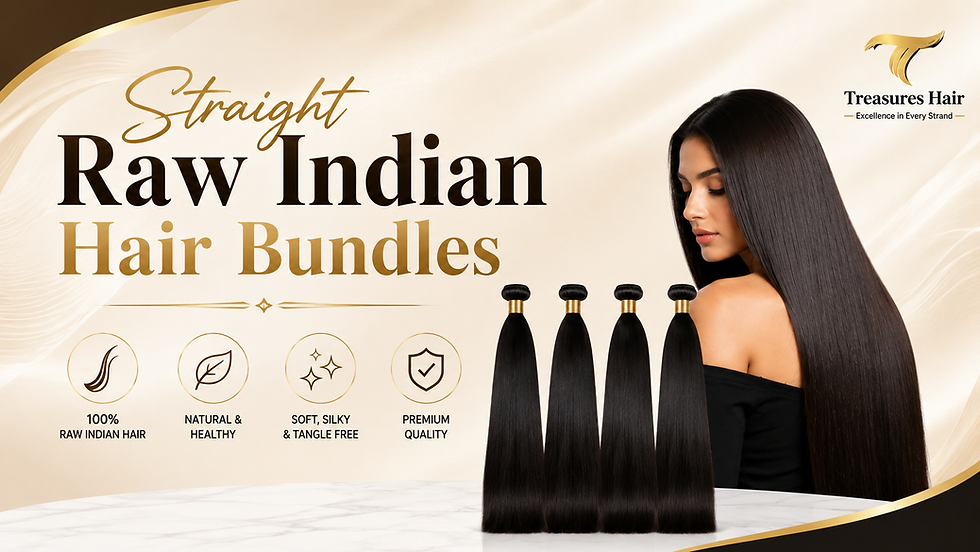
Straight texture grows from round, vertically positioned hair follicles and falls in a smooth, consistent line, requiring the least daily maintenance of the three textures, as covered in this dedicated guide to straight raw Indian hair bundles.
Wavy texture grows from slightly oval, angled follicles, producing soft, natural waves that offer more styling versatility, explored further in this guide to wavy raw Indian hair bundles.
Curly texture grows from more elliptical, angled follicles and offers the most volume and definition, though it requires the most moisture-focused care routine, covered in this guide to curly raw Indian hair bundles.
A peer-reviewed review of curly hair biology confirms that follicle shape, not processing or product use, is the primary driver of natural curl pattern, which is exactly why genuine raw hair in any of these three textures reflects real donor biology rather than a factory-applied style.2
Product Formats: Bundles, Closures, Frontals, and Wigs
Raw Indian hair is sold across several product formats, each suited to different installation methods and styling goals.
Weft bundles, the most common and versatile format, are sewn or machine-wefted strips of hair used to add length and volume in a sew-in install. A dedicated guide to raw Indian hair weft bundles covers construction types and application methods in detail.
Lace closures, typically 4x4, 5x5, or 6x6 inches, close off the crown section of a sew-in install with a natural-looking part, covered in this complete guide to 4x4 closures.
Lace frontals, spanning roughly 13 inches ear to ear, recreate the full front hairline and allow styles that pull hair away from the face, explored in the closure versus frontal comparison guide.
Full wigs combine bundles and a lace base into one pre-made unit, offering the fastest application at the highest price point.
How Long Raw Indian Hair Actually Lasts
Marketing claims about lifespan vary wildly across the industry, ranging from unrealistic six-month estimates to equally unrealistic five-year-plus promises. The honest, evidence-based range for genuinely raw, single-donor hair is 2 to 4 years of active wear with proper care, a figure explored in full detail, including the science behind it, in this honest lifespan guide.
Research on hair fiber weathering describes a progressive degradation pattern driven by mechanical and chemical stress accumulated over time, rather than a fixed expiration date.3 This is why lifespan varies meaningfully based on styling habits, heat exposure, and care routine, not just the hair's initial quality.
Can Raw Indian Hair Be Colored?
Yes, and it typically takes color and bleach better than processed commercial alternatives, precisely because its intact cuticle has not already used up its chemical tolerance on prior treatments. A complete guide to bleaching and coloring raw Indian hair covers safe lift levels and technique in detail.
The natural starting color of authentic raw Indian hair also matters here. It typically falls in the Natural 1B to dark brown range rather than a uniform jet black, a distinction fully mapped out in this raw Indian hair color chart. Buyers assuming all raw hair should look identically black are often looking at processed hair rather than genuine donor variation.
How to Verify You're Buying Genuinely Raw Hair
Because "raw" is not a formally regulated or certified term in the extension industry, verification falls largely on the buyer. A few practical checks help separate genuine raw hair from steamed or blended hair marketed under the same label.
Wash test the texture. Genuinely raw wavy or curly hair returns to its natural pattern after washing, since the texture was never chemically or thermally set. Steamed hair's pattern gradually relaxes with repeated washing instead.
Check for natural color variation. Authentic single-donor hair shows subtle natural variation rather than perfectly uniform, factory-matched color across every bundle.
Run fingers from root to tip. Aligned cuticles feel smooth in one direction and slightly rougher against the grain, a tactile check that blended or processed hair often fails.
Ask direct sourcing questions. A supplier who can describe their collection region, sorting process, and single-donor policy clearly is more trustworthy than one offering only vague "100% human hair" language.
Ethical Sourcing: What Buyers Should Know
Temple hair donation is a voluntary religious practice, not a commercial harvesting operation, which distinguishes it meaningfully from some other global hair sourcing models. Donors give their hair as an act of devotion, and temples typically auction the collected hair to licensed processors, with proceeds supporting temple operations and community programs.
For buyers concerned about ethical sourcing, this model generally holds up well under scrutiny compared to sourcing methods that rely on unregulated, unpaid, or coerced collection. That said, supply chain transparency still varies significantly between suppliers, and buyers who want assurance beyond general industry reputation should ask suppliers directly about their specific sourcing relationships and documentation practices. A supplier willing to describe exactly which temples or regions they source from, and how donated hair moves from collection to processing, is generally demonstrating a level of transparency that vaguer "ethically sourced" marketing claims do not provide on their own.
Raw Indian Hair Extensions: The Complete 2026 Buyer's Guide

Raw Indian hair is often compared to Brazilian, Peruvian, Malaysian, and Vietnamese hair, and understanding these differences helps buyers set accurate expectations rather than assuming all "raw" or "virgin" hair performs identically regardless of origin.
Indian hair tends to be finer in diameter than Brazilian hair while offering comparable strength, and it typically blends more seamlessly with a broader range of natural hair textures due to its naturally occurring range from straight to curly. Vietnamese hair is often marketed as an ultra-premium alternative, generally commanding a higher price point, though the actual performance difference between high-quality Vietnamese and high-quality Indian raw hair is often smaller than the price gap suggests. Buyers should evaluate specific supplier quality rather than assuming origin alone guarantees a particular performance level.
Cost Comparison: Raw Indian Hair vs Processed Alternatives Over Time
A fair cost comparison has to account for lifespan, not just the sticker price at checkout. Processed commercial hair often costs less upfront but requires replacement every 3 to 8 months under regular wear, while raw Indian hair, properly cared for, spans 2 to 4 years.
Run the math across a two-year period, and raw Indian hair frequently comes out ahead on total cost, even with its higher initial price, simply because it avoids three to six replacement cycles that processed hair would require in the same timeframe. This cost-per-wear framing is particularly relevant for salon owners setting client pricing and for resellers positioning raw hair against cheaper alternatives in their own marketing, and it is explored in more detail, with specific calculation examples, in the lifespan guide referenced earlier in this article.
Wholesale Considerations for Salons and Resellers
Buyers purchasing at volume face additional considerations beyond individual product selection. A dedicated guide to wholesale Indian hair extensions covers pricing benchmarks, minimum order quantities, and supplier vetting in depth, but a few points deserve mention here.
U.S. Customs and Border Protection classifies human hair wefts, closures, frontals, and wigs under Harmonized Tariff Schedule subheading 6704.20.0000, a classification wholesale importers should confirm with their own customs broker before shipping at volume.4 Marketing claims made to end customers, including density, weight, and drawing method claims, should also meet general truth-in-advertising standards, since the Federal Trade Commission requires that such claims be accurate and substantiated.5
Skin Safety Considerations for Adhesive-Based Products
Closures, frontals, and wigs installed with bonding adhesive carry documented skin safety considerations worth understanding before your first install. Peer-reviewed case reports have linked allergic contact dermatitis reactions to specific adhesive compounds used in wig and hairpiece attachment.6 The American Academy of Dermatology recommends a patch test before any product is applied directly to the scalp or hairline, a simple step that catches most sensitivities before they become a problem.7
Common Buyer Mistakes to Avoid
Assuming "raw" and "virgin" mean the same thing. These terms describe genuinely different processing levels, and conflating them leads to mismatched expectations about durability and cost.
Judging quality purely by price. While extremely cheap raw hair often signals a shortcut somewhere in sourcing or processing, extremely expensive hair does not automatically guarantee superior quality either.
Expecting uniform color and texture across every bundle. Natural variation is a sign of authentic single-donor sourcing, not a defect to complain about.
Skipping aftercare because the hair is marketed as "durable." Even the most resilient raw hair benefits significantly from proper washing, conditioning, and heat protection habits.
Care and Maintenance Basics
Raw Indian hair benefits from the same fundamental care principles regardless of texture or product format. Sulfate-free shampoo protects both natural moisture and any applied color. Regular deep conditioning, at minimum weekly for textured hair and biweekly for straight hair, maintains the cuticle's protective function over time. Heat protectant spray before any styling tool use reduces thermal stress on the hair shaft, and the American Academy of Dermatology's general guidance on limiting heat exposure applies directly to extensions as well as natural hair.
Storage between wears also matters more than most buyers realize. Keeping bundles, closures, or wigs on a mannequin head or wide-tooth hanger, away from direct sunlight, prevents the kind of tangling and premature weathering that poor storage habits accelerate.
Frequently Asked Questions
Is raw Indian hair worth the higher price compared to synthetic-blend or processed extensions?
For most buyers planning to reinstall or reuse the same hair over time, yes. The longer realistic lifespan and better chemical tolerance typically offset the higher upfront cost within one to two reinstall cycles.
Can I mix raw Indian hair with my own natural hair texture seamlessly?
Yes, particularly when the texture is matched correctly. Straight raw hair blends best with straight or fine natural hair, while wavy and curly raw hair blend more convincingly with textured natural hair.
How many bundles do I need for a full head install?
This varies by length, texture, and desired volume, but most full installs use between 2 and 4 bundles, with curly textures often requiring one additional bundle due to how curl pattern affects perceived volume.
Does raw Indian hair shed more than processed hair?
Generally less, provided it is genuinely single-donor and properly wefted. Shedding is more commonly linked to poor weft construction or blended, lower-quality sourcing than to the raw classification itself.
Can raw Indian hair be permed or chemically restyled?
Yes, though this uses up some of the hair's structural reserve the same way bleaching does. Spacing out chemical services and following proper technique helps preserve overall lifespan.
Is all hair labeled "Indian temple hair" genuinely raw?
Not necessarily. Some suppliers use "temple hair" language while still applying processing after collection. Direct sourcing questions and wash-test verification remain the most reliable ways to confirm authenticity.
Does raw Indian hair work well for wig-making, or is it better suited to sew-ins?
It works well for both. The same single-donor quality that benefits a sew-in bundle also makes for a durable, natural-looking wig base, with the choice between formats coming down to styling preference rather than hair suitability.
How does raw Indian hair compare in price to Vietnamese or European hair?
Raw Indian hair is generally more affordable than premium Vietnamese or European hair while offering comparable durability and versatility, making it a strong value option across most budget ranges.
The Bottom Line
Raw Indian hair extensions represent the least-processed, longest-lasting category of human hair extensions available today, but that value only holds true when the hair is genuinely single-donor and unprocessed as claimed. Understanding what to verify, how to care for it, and which product format fits your specific goal turns raw Indian hair from a marketing term into a genuinely informed purchase. Explore Tressley Hair's full range of raw Indian hair products, backed by transparent, single-donor sourcing standards, or request a wholesale quote to see the difference for yourself.


Comments